THE HEALTHY LIVING JOURNAL
Whole Grains vs. Refined Grains: How to Read the Label
Learn how to spot whole grains in the ingredient list, understand common package terms, and make a practical choice without relying on bread color.
General educational information · Sources listed below
Start with the ingredient list
Whole grains and refined grains can look surprisingly similar on the shelf. Brown bread is not necessarily whole grain, and a package covered in seeds does not tell you which flour forms most of the product. The ingredient list is a more useful starting point than color or a rustic-looking wrapper. [1]
You do not need to memorize every grain name. Learn a few reliable clues, compare the foods you buy most often, and choose something you enjoy eating. That turns label reading into a quick shopping habit rather than another complicated food rule.
What makes a grain whole?
A whole grain contains the bran, germ, and endosperm. Refining removes the bran and germ, changing the grain's fiber and nutrient content. Enriched refined grains have some nutrients added back, but enrichment does not recreate the original grain or automatically restore its fiber. [1,2]
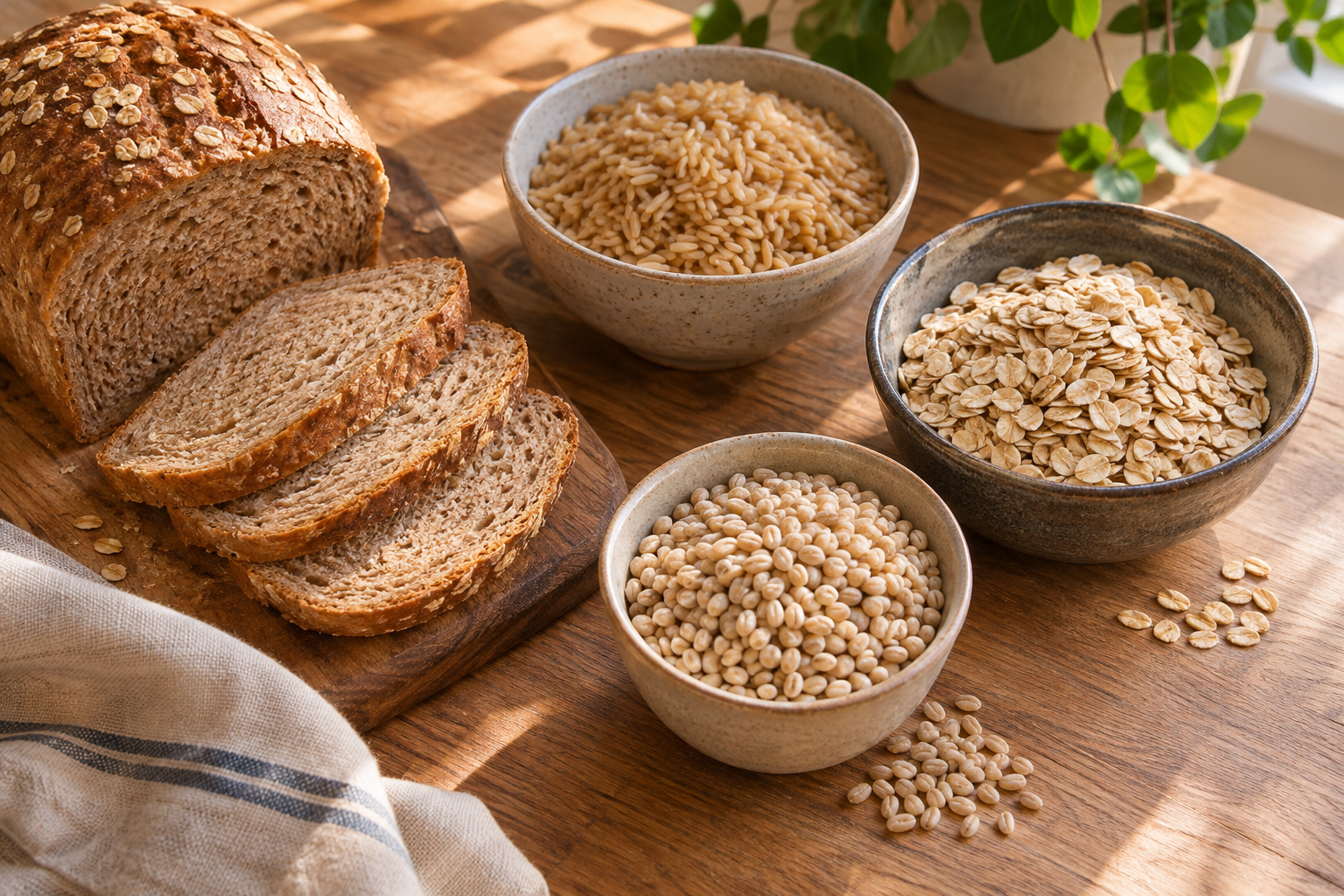
Oats, brown rice, barley, and whole-wheat flour are familiar examples to explore. Products can contain a mixture of whole and refined grains. A blend may still fit your meals, but it is helpful to understand what you are purchasing instead of treating every grain-based food as equivalent.
Read the first few ingredients
Look for a clearly identified whole grain, such as whole-wheat flour, among the leading ingredients. Ingredients are generally listed in descending order by weight, so their position offers useful context. Compare like with like: two sandwich breads or two breakfast cereals, rather than unrelated serving sizes. [3]
For example, if one bread begins with whole-wheat flour and another begins with enriched wheat flour, the lists are describing different starting ingredients. You can use that information alongside price, taste, and the rest of the label. A front-of-package slogan should not replace this check.
Understand words that can be misleading
“Multigrain” tells you that more than one grain is involved; it does not establish that every grain is whole. Similarly, the word “wheat” alone is not the same as “whole wheat.” Terms that describe processing or appearance may not answer the question you are asking. [1,2]
Be equally careful with photographs of grains, dark coloring, or a coating of seeds. Those features may be appealing, but they are not a dependable way to identify the flour inside. Read the actual ingredients even when the package looks particularly wholesome.
Compare fiber without overlooking the whole food
The Nutrition Facts panel can help compare fiber per serving. Check the serving size first, because a larger portion can create an apparently larger nutrient number. Also consider sodium and added sugars when comparing products you eat regularly. One attractive figure does not summarize the entire food. [4]
A whole-grain choice does not have to be a specialty snack with a health claim. Plain oats, a bag of brown rice, or a bread you already like may be a practical place to begin. Choose foods that work with your meals and budget rather than buying an ingredient you will not use.
Make the change fit your kitchen
Try one substitution at a time. Mix brown and white rice if your household prefers a gentler change, or use whole-grain toast for a breakfast you already make. Keep cooking times in mind so a longer-cooking grain does not disrupt a rushed evening.
If a particular texture disappoints you, try a different preparation rather than concluding that all whole grains taste alike. Leftover cooked grains can work in bowls or soups when stored and reheated safely. You can build variety gradually without replacing every familiar food at once.
A quick shopping routine
Pick one grain food on your next trip. Check the grain named in the ingredients, compare equal serving sizes, and choose a product you can realistically use. Save the label comparison for that category instead of trying to investigate the entire store.
People with celiac disease or another prescribed dietary restriction need additional checks: whole wheat is still wheat, and “whole grain” does not mean gluten-free. Follow your own dietary guidance. For everyone else, a repeatable label-reading habit is more useful than judging a food by its color alone.
Explore the sources
- American Heart Association: Whole and Refined Grains ↗
- Academy of Nutrition and Dietetics: Whole Grains ↗
- FDA: Food Ingredients and Label Order ↗
- FDA: Nutrition Facts Label ↗
Prepared with AI assistance for True Healthy Products LLC. Sources inform this educational guide; their inclusion does not imply endorsement of our company or products. See our editorial approach.